
No Riley 72-Hour Release Feed
RCPD publishes no official rolling 72-hour roster of jail releases. Its Monday Daily News report is the closest local weekend proxy because the arrest collection period runs from Friday at 6:00 a.m. through Monday at 6:00 a.m. That report can gather weekend arrests and Monday confinement clues in one place. It must not be renamed or described as a three-day release list.
The distinction is more than a label. The Daily News and Media Arrest Report focus on arrests and status. They do not list a release date, release time, reason, destination, or receiving agency. A line that says CONFINED RCJ: NO means only that the person was not confined at Riley County Jail when the report snapshot was prepared. It does not show whether the person returned to the community.
Riley Weekend Status Window
Weekend searches need a different approach from same-day checks. The Monday report spans the Friday-to-Monday arrest collection period, while ordinary weekday reports generally cover one 6:00 a.m.-to-6:00 a.m. interval. This schedule can help locate an arrest entry that otherwise falls between daily checks. It does not establish a release cadence, and no official source gives a holiday release-report schedule.
Start with the RCPD Daily News archive. Match the report date and stated collection period to the dates at issue. Then compare the person’s full name, age or hometown, arrest agency, case number, charge, and arrest time. Read the confinement value as a snapshot, not a release certificate. If a report changes or disappears, the web archive alone should not be used to settle what occurred.
RCPD says Daily News arrest summaries remain published for 48 hours after arrest. That online period is shorter than a full three-day search in some cases. It also refers to arrest-summary publication, not to retention of the underlying booking or release record. Request the agency record when the report is absent, unclear, or too old.
Check Riley County Three-Day Releases
Use a layered search rather than trying to force one source into the role of a release roster:
- Review the Daily News entries that overlap the full three-day period. Include the Monday report when the window covers a weekend.
- Match identity and case details. Do not select a near-name result without other facts.
- Note any “no longer confined” wording or CONFINED RCJ: NO field, but preserve the report date and as-of context.
- Search the person in Kansas VINE if the event concerns Riley County Jail. VINE can show a county-jail status or send a custody-change notification.
- Check the Riley County District Court case for a bond order, disposition, sentence, dismissal, or other filed authority.
- Send RCPD Police Records a focused request for the booking and release record, including release date, time, type, and destination if maintained.
- If evidence points to a KDOC transfer, leave VINE and use KASPER for the state-corrections status and movement history.
This method also prevents a common error. Riley County Jail is operated by the Riley County Police Department. There is no separate Riley County sheriff release feed to search. Official local requests and jail questions should go to RCPD.
Riley Three-Day Report Fields
The arrest report offers detailed identifiers, but its fields describe the arrest and a later confinement snapshot.
| Field group | How to use it |
|---|---|
| Name, age, hometown, sex | Compare identity details and avoid a false match. |
| Agency code and custody type | Identify the reporting arrest agency and arrest category. |
| Arrest date, time, location | Place the arrest inside the reporting period. These are not release details. |
| Bond totals | See the bond reported with the arrest. A listed amount does not prove bond was posted. |
| CONFINED RCJ | Read whether the report showed Riley County Jail confinement at its snapshot. |
| Charge, statute, count, case | Use the case information to locate the court record and filed order. |
Notably absent are the exact release event, time, reason, destination, and photograph. A request may ask for those items, but the custodian determines what exists and what is disclosable.
Why Riley’s Proxy Is Different
Riley County’s local proxy is unusual because the automated PDF gives a direct yes/no confinement field. That clarity is useful, yet it can also invite overreading. “NO” does not mean “released on bond at a specific time.” It means “not confined here” at the report’s as-of point. The same value can follow a transfer or another custody change.
A Daily News narrative may add language such as “no longer confined,” but it is still not the durable release record. RCPD’s web publication period also does not define how long the underlying agency file is retained. Keep a note of the report date and the identity fields used, then follow the case into the court system or request the local record.
For a narrow same-day check, use the Released Last 24 Hours guide. It explains release-day pickup, transportation, bond procedure, and the limits of local photo and app channels.
Request Riley County Release Proof
RCPD Police Records is the direct local fallback. The office is at 1001 South Seth Child Road, Manhattan, Kansas 66502, and the main phone is 785-537-2112. RCPD documents request channels that include in person, mail, email, fax, and online submission. Provide the person’s name, aliases or date of birth, the arrest or booking date, and a case or incident number when known.
Be precise about the record. Ask for the booking and release record and name the desired fields: date, time, release type, destination, and booking photograph if maintained. The agency may need clarification. Kansas open-record procedure calls for a response within three business days when a record cannot be produced at once, but that response may be an acknowledgment, an explanation of delay, or a denial rather than the requested pages.
The record custodian may charge fees based on actual costs. The Kansas public-records statutes shown below explain the request framework. Review the official K.S.A. 45-218 request provision before relying on the captured text.
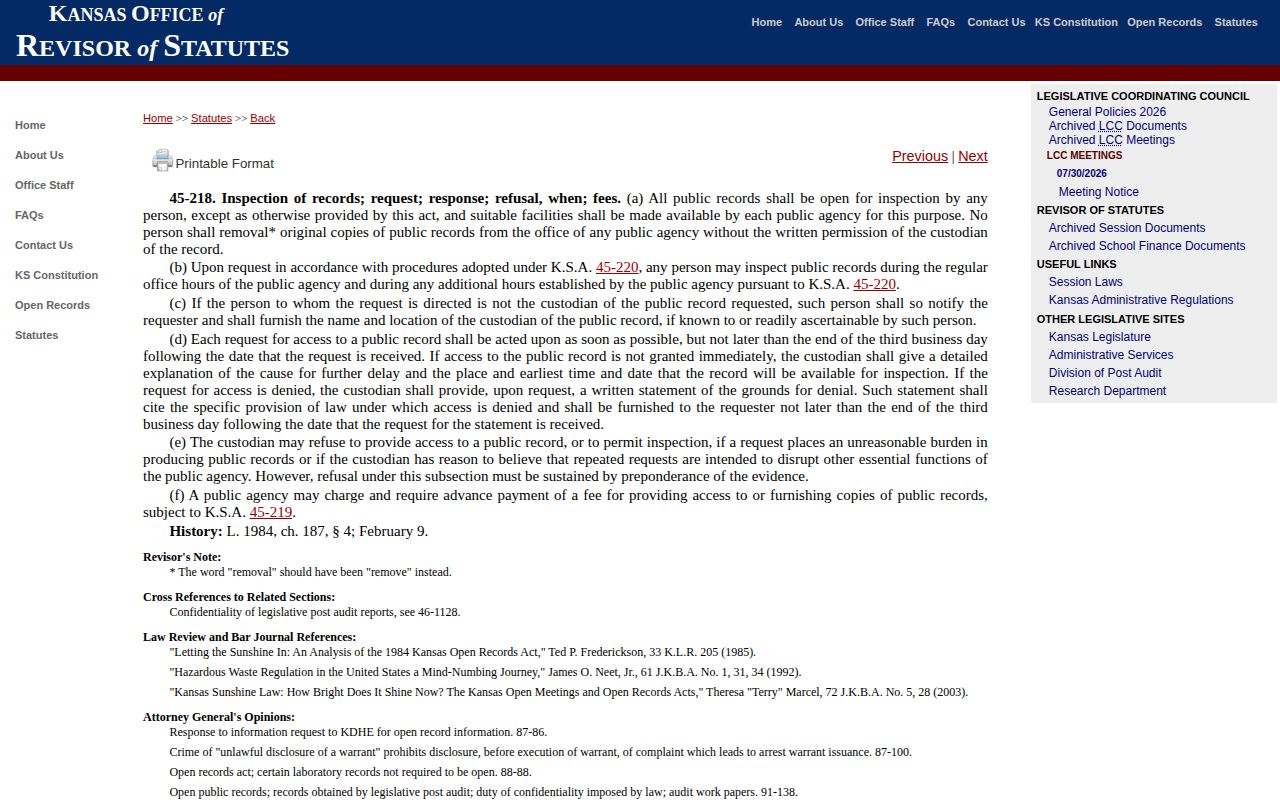
The statute supplies procedure, not proof that a particular release field exists. A focused request gives the custodian the best chance to identify the correct responsive record.
Route Riley Release Checks Correctly
Use Kansas VINE for a named person in a participating county jail. It can send a notice for release, bond-out, transfer, escape, or another custody change based on the event feed. It does not provide a guaranteed historical archive, and Kansas publishes no official post-release retention window for VINE.
Use KASPER after a transfer into KDOC or for a state prisoner. KASPER can show custody, supervision, discharged status, movement history, conviction and case details, and anticipated release information when applicable. It is not proof of a Riley County Jail bond release. Federal Bureau of Prisons and ICE custody require their own official locators. A no-match in a current-custody system does not, by itself, prove community release.
Finally, use the court file for legal authority. Riley County District Court handles state criminal matters, while a Manhattan Municipal Court case may concern a city-ordinance arrest. Dockets help locate a case, but the filed order or disposition is stronger evidence than a schedule entry. Combining custodian, custody system, and court record is the sound way to reconstruct a three-day release window.
Public Record Search
Sponsored Results