
Riley County Projected Release Dates
Kansas official sources use “anticipated release date” and “Earliest Possible Release Date,” often shortened to EPRD. EPRD reflects the sentence structure and credits known when KDOC computes the record. It is not a certificate that the person left custody on that date.
An actual release date records what occurred. The event may be release to postrelease supervision, parole, sentence discharge, or transfer. These outcomes have different legal effects. A person can leave prison but remain under KDOC authority. A move from Riley County Jail to a state prison ends local confinement without a return to the community.
A pretrial Riley County Jail detainee has no sentence-based EPRD. Bond, a new court order, dismissal, or another custody event controls that exit. A court schedule may identify a hearing, but the schedule is not an order and does not establish release.
Find a Riley County Release Date
Start by identifying whether the person is in the county jail or KDOC. KASPER is not a Riley County Jail release calendar. RCPD cannot compute a KDOC prison date from a short charge description. The correct source follows the present custodian and sentence.
- Identify the last known facility and court case.
- For KDOC, open KASPER and accept its scope and update warning.
- Search by KDOC number when possible, or match name, birth details, and conviction case.
- Read the exact EPRD, anticipated-date, status, and movement labels shown.
- For Riley County Jail, obtain the sentencing journal entry and ask jail staff for the calculated date.
- After the date, verify actual release, transfer, or supervision with the matching record.
KASPER supports last name, first name, middle name, aliases, KDOC number, state ID, birth date, age range, conviction county, and parole-supervision county. Conviction county is not current location. A Riley filter should be used only when the case or supervision field truly relates to Riley County.
The broader Riley County released inmate record path shows how to combine jail, court, state, and release records when the custodian is uncertain.
Kansas Good Time for Riley Releases
K.S.A. 21-6821 governs modern Kansas good-time and program credit. For crimes committed on or after July 1, 1993, the general maximum good-time reduction from the prison portion is 15 percent. That produces the familiar estimate of serving about 85 percent only when all available credit applies, is earned, and remains intact.
Specified nondrug severity-level 7 through 10 cases committed on or after January 1, 2008, and specified drug severity categories, can receive up to 20 percent. Eligible program credit is capped at 120 days. These rules do not apply in the same way to every offense date, off-grid sentence, mandatory minimum, or severity level.
For crimes before July 1, 1993, K.S.A. 22-3725 provides a different indeterminate framework. KDOC’s glossary describes old-law good time as potentially 50 percent, while determinate credit can be 15 or 20 percent depending on the case. A person-specific date must come from the official computation.
The successful statute image comes from K.S.A. 21-6821.
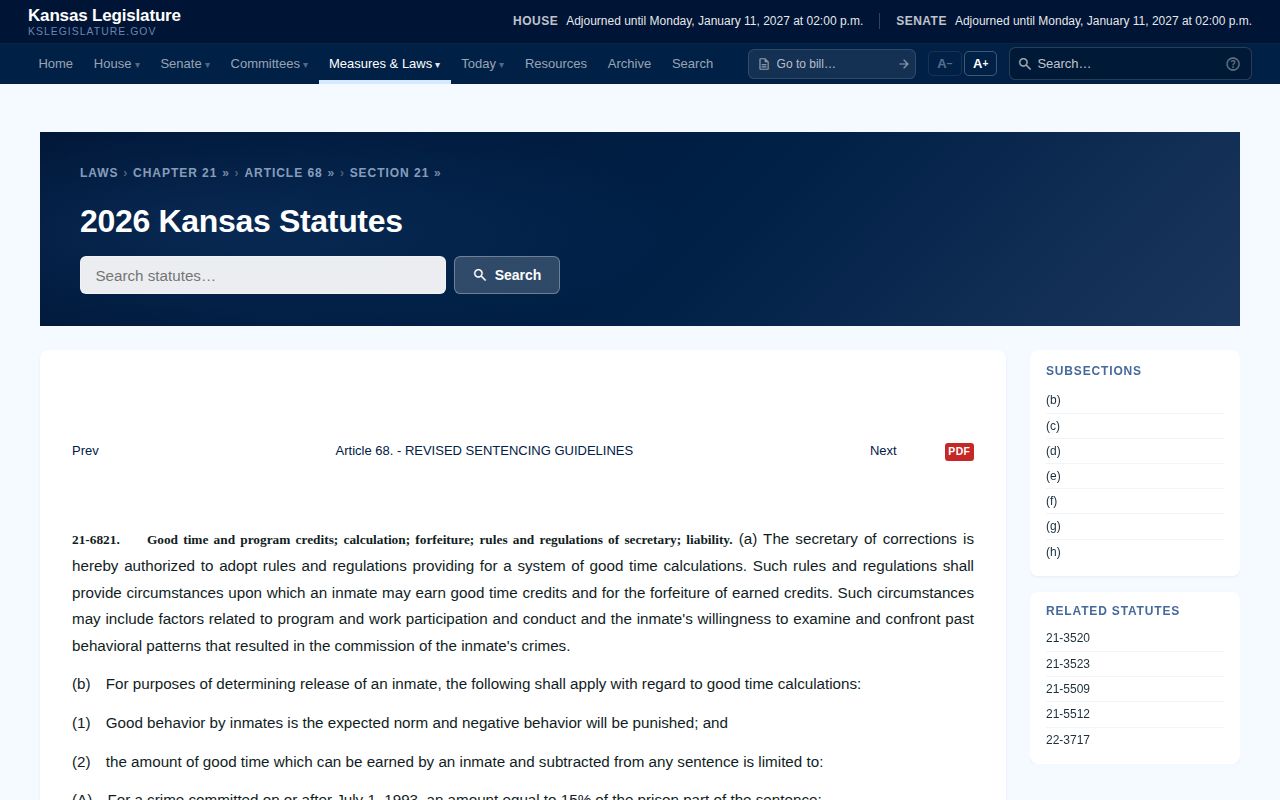
The statute supports the credit limits, but KDOC applies them to the actual sentence and conduct record.
Changes to Riley Release Dates
An EPRD can move in either direction. Credits are only one factor. Sentence corrections, later cases, or a hold from another authority may change what happens at the end of one custody period.
| Event | Possible effect |
|---|---|
| Earned and retained good time | Moves earliest prison release earlier within legal limits |
| Disciplinary forfeiture | Can move EPRD later |
| Eligible program credit | Can reduce eligible prison time within the cap |
| New or consecutive sentence | Changes the controlling sentence |
| Board denial or pass | Prevents parole at that review in an eligible case |
| Detainer or transfer | Ends one placement without community release |
| Court correction or appeal | Can change sentence authority |
| Data lag | Public display may trail the operative record |
KASPER is updated on working days, with KDOC guidance describing daily updates excluding weekends. Save the label and access date. If a result is inconsistent, KDOC provides a correction route and handles sentence-computation questions through its central number.
Riley Jail Sentence Dates
A person serving a Riley County Jail sentence generally will not receive a KASPER EPRD unless the person is in a KDOC-funded program. Obtain the sentencing journal entry from the correct court. Then ask RCPD jail staff or records for the calculated local release date and any existing release record.
Riley County District Court handles state criminal cases. Manhattan Municipal Court can handle city-ordinance cases even when RCPD made the arrest and jail booking. The court source must match the charge. Riley’s daily docket updates on workdays but warns that recent changes may not yet be processed.
A docket entry is navigation, not proof. Read the filed order. For an actual exit, use the RCPD release record with the date, time, type, authority, and receiving agency if those fields are maintained.
Note: County jail release can depend on bond or court action and should not be estimated from Kansas prison credit percentages.
Parole and Riley Release Timing
Parole chiefly applies to eligible indeterminate or old-law cases. Eligibility is only the first stage. The Kansas Prisoner Review Board can grant parole, deny or pass, continue a decision, or require service to another release point. Most on-grid determinate cases committed after July 1, 1993 instead leave the prison portion to mandatory postrelease supervision.
The official Prisoner Review Board process explains this divide.

The process source prevents an upcoming review month from being mistaken for a granted release date.
Good time can reduce the prison portion while some of that time is added to mandatory postrelease. It does not always erase the remaining legal duty. Read K.S.A. 22-3717 with the sentence rather than treating physical prison exit as full discharge.
Confirm a Riley Actual Release
After the displayed date, read KASPER status and movement history. A parole-office or postrelease status shows that prison custody changed while supervision continues. A discharged status addresses a stronger endpoint, though the precise discharge document may still be needed.
For Riley County Jail, compare Kansas VINE, the RCPD record, and the court file. VINE can alert to a county-jail release or transfer, but Kansas VINE excludes KDOC prison residents and is not a permanent archive. For state prison, use KASPER and KDOC channels.
A detainer may transfer the person to another custodian. A no-longer-confined label, missing search result, or past EPRD does not rule out another jail, prison, federal, or immigration placement. Confirm destination before describing community release.
Note: The most reliable date is the one recorded after the event by the agency that held or supervised the person.
Riley County KASPER Date Fields
KASPER can present sentence structure, controlling sentence, sentence-begins information, anticipated release information, parole eligibility, conditional release, expiration, movement history, supervision location, custody level, discipline, and a photograph among public fields. Not every field appears for every sentence. Record only labels shown on the matching result.
An exact KDOC number is the strongest key. With a name search, combine birth details, physical description, conviction county, and case. Search aliases where appropriate. A photo can distinguish two people, but KDOC warns its image database date can differ from the actual photograph date.
KASPER covers people incarcerated, under post-incarceration supervision, and discharged from sentences since about 1980. It is not a complete criminal history or proof of a Riley bond release. Sentence-computation questions route to KDOC at 785-296-3317.
Riley Release and Sentence Discharge
KDOC terms separate conditional release, supervised release, and maximum-sentence discharge. A person outside prison on parole or postrelease remains under legal authority. Maximum-sentence discharge means the KDOC sentence and supervision have ended. Those dates cannot be merged.
- EPRD
- Earliest Possible Release Date under current sentence and credit data.
- Postrelease
- A required community period after many determinate prison terms.
- Parole
- Discretionary supervised release after Board action in an eligible case.
- Discharge
- The formal end of sentence or supervision authority.
Good time can reduce the prison portion but add to mandatory postrelease. An earlier prison exit may not shorten the whole legal obligation by the same amount. Read the sentence with K.S.A. 22-3717.
Riley County Date Evidence
Strong evidence includes a signed release or discharge certificate, jail release record, custody-change event, and official status or movement entry. A report snapshot is weaker. Disappearance from a result is weakest because transfer, lag, spelling, scope, or expungement can change display.
For older local events, request the RCPD record and inspect the court file. For KDOC, request a narrow face sheet, release certificate, parole certificate, or discharge certificate when KASPER does not answer the date question. Retention does not make every narrative public.