
Riley County Parole and Probation
Kansas uses several community-supervision systems. Their labels are not interchangeable. Parole chiefly concerns eligible old-law, indeterminate, or certain off-grid sentences. The Kansas Prisoner Review Board decides whether an eligible person is suitable for parole. Eligibility only permits review. It does not prove that release was granted.
Postrelease supervision follows most determinate guideline prison terms for non-off-grid crimes committed on or after July 1, 1993. These people usually leave the prison portion for a required period of KDOC supervision. Probation is different. A judge orders it as a community sentence or sanction, sometimes after a Riley County Jail release.
| Supervision | Who orders it | Riley County verification |
|---|---|---|
| Parole | Kansas Prisoner Review Board in an eligible case | KASPER status and KDOC office |
| Postrelease | Required by the Kansas sentence | Sentence entry, KASPER, and KDOC |
| Probation | District or municipal court | Court order and assigned local office |
| Final discharge | Board, court, or sentence expiration | Discharge certificate or filed termination |
The distinction changes where a record lives. Riley County Court Services handles probation and bond-supervision functions. Riley County Community Corrections supervises moderate- and high-risk adult felony clients on intensive supervision in the 21st Judicial District. KDOC parole and postrelease cases route through a state field office.
Verify Riley County Postrelease Status
Begin with the sentence source, not a general name search. A Riley criminal court record can show whether the judge ordered probation or imposed a prison sentence with postrelease. KASPER is the official Kansas corrections repository for a person sentenced to KDOC custody. It can show incarcerated, post-incarceration-supervision, and discharged statuses, subject to working-day updates.
- Identify the court case and compare the person’s full name and case number.
- Read the sentencing journal entry for prison, probation, and postrelease terms.
- Search KASPER by name, then confirm with a KDOC number when available.
- Compare status, conviction county, movement history, and parole-supervision county.
- Contact the listed supervising system for process or record-routing questions.
- Obtain the final discharge or termination record when supervision appears complete.
KASPER has an important local limit. It warns that Community Corrections probation events after April 21, 2021 cannot be displayed. A missing recent event is not proof that Riley County Community Corrections supervision ended. Use the court file and the local agency for the current record path.
The Riley County released inmate search explains how the supervision record fits with jail, court, VINE, and release records. Keep the exact status label and access date because a working-day display can trail a change.
Riley County Supervision Offices
A state parole or postrelease case for Riley County routes through the Junction City Parole Office. Court probation and intensive Community Corrections are separate. Contact the office that matches the sentence rather than treating all three as one department.
Kansas Department of Corrections
446 Grant Avenue
Junction City, KS 66441
785-238-1911
Serves Riley, Geary, Marshall, and Morris counties
100 Courthouse Plaza, Room 100
Manhattan, KS
785-537-6360
Monday through Friday, 8:30 a.m. to 5:00 p.m.
115 North 4th, 2nd Floor West
Manhattan, KS
785-537-6380
Monday through Thursday, 7:30 a.m. to 5:00 p.m.; Friday until noon
These contacts support process and records routing. They do not promise disclosure of protected supervision narratives. K.S.A. 22-3711 protects preparole, pre-postrelease, and supervision-history material, even when basic status or office fields are public.
The official Riley County Community Corrections page provides the local intensive-supervision source.
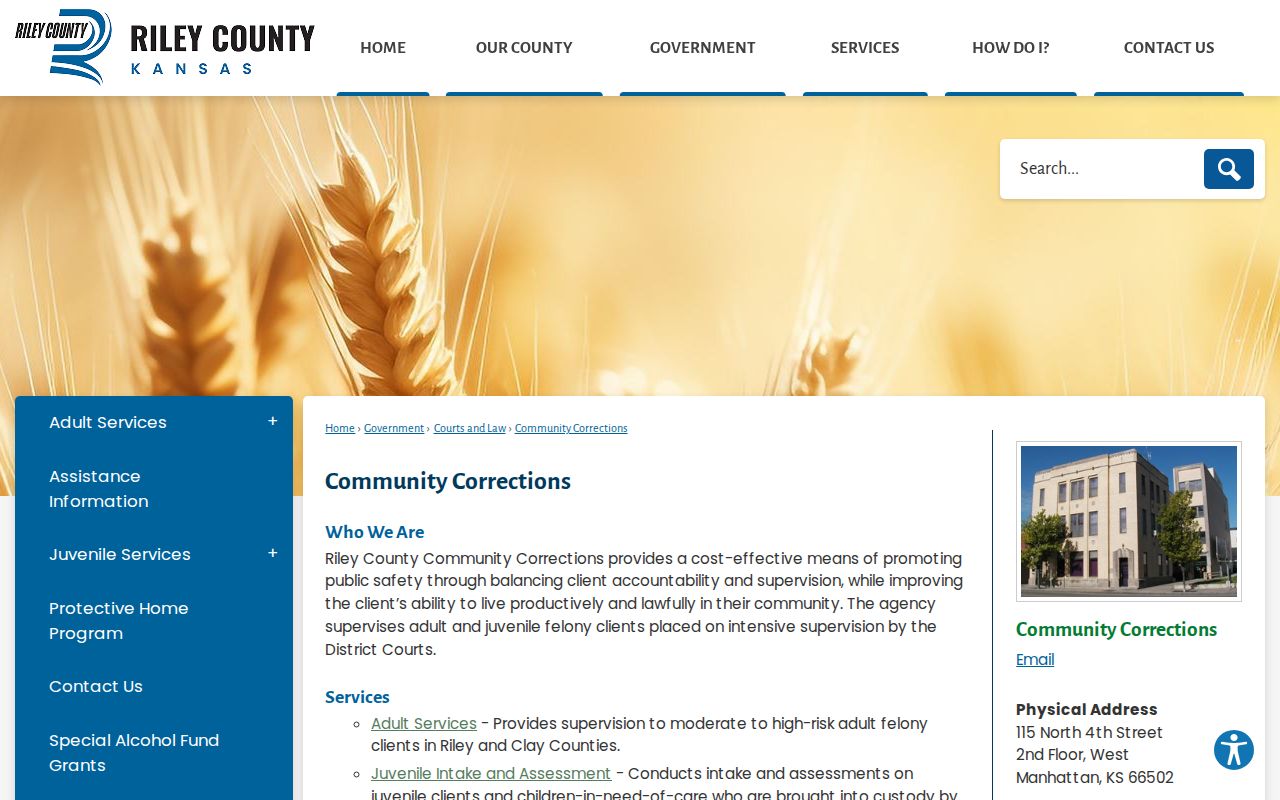
This local source distinguishes Community Corrections from KDOC parole and ordinary court probation.
Riley County Absconder Records
An absconder is a person reported as having left supervision without authorization or stopped maintaining required contact. KASPER provides one absconder search for parole and another for Community Corrections. The parole search can filter by the supervision location before absconding, including Riley County. The separate Community Corrections tab reflects a different supervision system.
- Absconder
- A person reported as missing from required supervision contact.
- Violation
- An alleged failure to follow a condition, subject to agency and court process.
- Revocation
- A formal action that can end community placement and return a person to custody.
- Discharge
- The formal end of the sentence or supervision authority.
An online absconder result is not a current physical locator. It does not prove a new jail booking, a current warrant, or the person’s present address. KASPER warns against making an arrest based only on its display. Working-day update limits also apply.
The successful image below comes from the official Kansas parole absconder search.
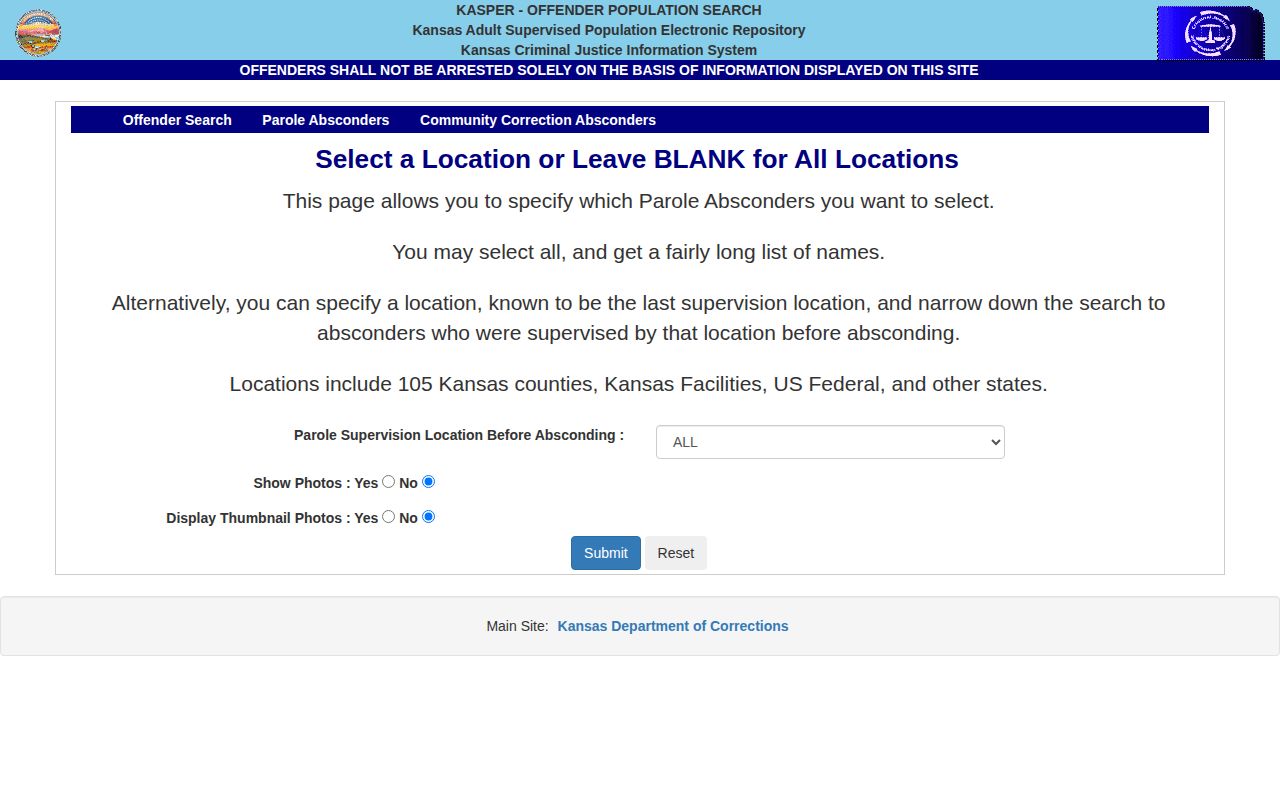
Its filter is useful for the last supervision location, but it is not a live map of the person.
Riley County Warrants After Release
RCPD’s warrant list is a lead, not proof that a warrant remains active. This local distinction matters when a released person appears in an online list. A warrant may create a new custody risk, but the list does not establish present location, a new booking, or the outcome of later court action.
Keep the warrant question separate from supervision status. A parole absconder record, Community Corrections absconder record, court warrant, and jail custody record answer different questions. Compare the name and case, then verify with the agency that created the record.
Do not attempt to detain or confront anyone based on an online entry. Contact the police or supervising agency when safety or an active order is at issue.
Riley County Supervision Conditions
Conditions depend on the sentence, offense, order, and supervising system. Common categories can involve reporting, lawful conduct, travel approval, residence, treatment, testing, or financial duties. Public basic fields do not reveal every condition or the protected facts behind a response. The controlling sources are the filed order and agency record.
K.S.A. 22-3717 provides common postrelease periods of 36 months for specified higher severity levels, 24 months for specified middle levels, and 12 months for specified lower levels. Offense date, severity, special sentencing rules, and earned reductions can change the result. Some offenses carry far longer or lifetime duties. A short charge label is not enough to calculate a Riley County term.
A violation allegation is not the same as revocation. Depending on the system, the matter can involve notice, an agency response, a court hearing, a Board decision, or a custody event. Check later orders and KASPER movement rather than inferring an outcome from an early allegation.
Riley County Final Discharge
Physical release and legal discharge are separate dates. A person can leave prison on parole or postrelease while KDOC authority continues. A person can leave Riley County Jail on probation while the court case and supervision continue. Final discharge or termination supplies the stronger record that the remaining duty ended.
Under K.S.A. 22-3722, the Board can issue an order and certificate of final discharge after satisfactory service on parole or conditional release, generally not sooner than one year after release unless the sentence expires earlier. KDOC terminology treats maximum-sentence discharge as the end of KDOC authority.
For probation, look for a filed termination, discharge, or later court order. For state supervision, check KASPER and request the discharge certificate or public order when needed. An old “released” entry alone does not answer whether supervision ended.
Note: A supervision end date may also affect when an eligible person can begin an expungement waiting period under Kansas law.
Riley County Parole Decisions
The Prisoner Review Board publishes monthly public-comment sessions and an upcoming list. A KDOC number, case, hearing month, and possible release month show a review pipeline, not a grant. Outcomes include granted, denied or passed, continued, or service to another release point. Obtain the person-specific decision and later KASPER status before stating that release occurred.
Kansas VINE serves a different role. It covers Riley County Jail events but excludes KDOC prison residents. A jail alert cannot verify state parole, and KASPER cannot replace a local probation file. Match each question to the agency with authority.